Category Archives: television

Cautious optimism about the postponement of Nazi War Diggers

updated 2:30 p.m. EST with two more links at the end of the post.

I was on campus until rather late last night and didn’t get a chance to update the list of articles critiquing and opposing the National Geographic Channel’s Nazi War Diggers, a proposed 4 part series which appeared to portray archaeology as treasure hunting and showed human remains being excavated in a grotesquely cavalier manner.

My previous link round-up posts are here: Nazi War Diggers: Part II and here: Nazi War Diggers: Part I.

There are some excellent articles that I’ll link to at the end of this post, but I’m going to start with the good news Tom Mashberg reported in the New York Times: “National Geographic Channel Pulls ‘Nazi War Diggers’ Series.”

It should be noted that the show does not appear to have officially been cancelled – it has been “postponed indefinitely,” which can mean a lot of things in the world of broadcast media and video on demand.

Still, it’s a positive sign and one that the National Geographic Channel should be given credit for, particularly in light of how firmly they seemed to be digging their heels in as recently as Friday.

I want to highlight a few sections of the article since it may be behind a paywall for some readers.

First, it’s important to note that the National Geographic Society did listen to the archaeologists affiliated with the society and acknowledged their concerns:

National Geographic Channel said Monday that it would “indefinitely” pull a planned television series on unearthing Nazi war graves after days of blistering criticism from archeologists and others who said the show handled the dead with macabre disrespect.

The channel said that after “consulting with colleagues” at the National Geographic Society, it would not broadcast the series, “Nazi War Diggers,” in May as scheduled “while questions raised in recent days regarding accusations about the program can be properly reviewed.” The show was to have been broadcast globally except in the United States.

Additionally, this section explaining that the Latvian War Museum opposed the show is important because inaccurate rumors about their involvement could have serious consequences for them in the future:

The channel said in its Friday statement that the Latvian government had approved the team’s work, which took place on Latvian and Polish soil. But the critics contacted the Latvian War Museum, which said in a statement that it had opposed the show.

National Geographic also said that none of the items dug up during filming would be sold but instead would be donated to war museums. The critics however found a posting on a military collectors’ online forum in which Mr. Gottlieb described locating a Latvian war helmet in June and preparing it for sale.

On to the links I intended to post yesterday, which raise many relevant questions and concerns and explain why NatGeo TV’s defensive arguments on Friday were so problematic.

I think these are vital reads regardless of the fate of the show because they get to a lot of larger issues that archaeologists, public historians, curators, and others face on a regular basis, particularly in the age of Infotainment and manufactured television “reality.”

Sam Hardy at Conflict Antiquities: ‘No trouble with customs.’ Perhaps trouble with repeatedly written confessions?

Alison Atkin at Deathsplanation: “On the Importance of Context.”

updates:
Andy Brockman at Heritage Daily: Springtime for Hitler and “Nazi War [Death Porn] Diggers”

Additionally, this letter from the Presidents of a number of major anthropological and archaeological professional organizations has been added to the American Anthropological Association site:

The Society for American Archaeology (SAA), the Society for Historical Archaeology (SHA), the Archaeological Institute of America (AIA), the American Anthropological Association (AAA), the European Association of Archaeologists (EAA), and the European Association of Social Anthropologists (EASA) wish
to express our deep disappointment and grave concern about the upcoming National Geographic Channel
International’s (NGCI’s) show, Nazi War Diggers. Together, SAA, SHA, AIA, AAA, EAA, and EASA
represent more than 10,000 professional archaeologists and more than 600,000 individuals interested in
archaeology. Our members live and work in all parts of the world, including the areas ravaged by World
War II.

(read the rest of the letter here).

Nazi War Diggers, part II

Yesterday, I posted about a new NatGeo TV show, Nazi War Diggers. The list of blog posts and open letters criticizing the show continues to grow.

Alison Atkin (Deathsplanation, doctoral researcher at The University of Sheffield Department of Archaeology) “Dear National Geographic Channel UK.” This post also contains a pdf of the letter the National Geographic Channel has sent out in response to the outcry.

Dr. Donna Yates (research fellow on the University of Glasgow’s Trafficking Culture project): “Nazi War Diggers: Looting war graves on TV.”

Paul Mullens (Archaeology and Material Culture, Chair of the Anthropology Department at Indiana University-Purdue University, Indianapolis): “The Peep Show of Death: Televising Human Remains.”

Even as the National Geographic Channel scrambles to argue that everything will be fine once we see the context of the clip, they fail to acknowledge a key issue. As Mullens writes:

Shows that tear bottles and bullets out of archaeological context violate archaeological ethics because they make no effort to systematically interpret the material record and they quite often recover things simply for commercial benefit. Reducing human bodies to the same status as bottles to be trafficked online has consequential methodological, ethical, and moral implications alike.

Tom Mashberg’s New York Times article, “TV Series is criticized in handling of deceased,” will hopefully reach an audience beyond the bio/archaeology community. The National Geographic Channel is quoted in the article:

“Part of it is our fault because we released a clip completely out of context that was not representative of the show,” he said. “But I hope people will withhold judgment until the show starts.”

This raised many an eyebrow on twitter. The clip, which shows a group of men cavalierly scraping dirt away from human remains and prying a broken femur out of the ground in a manner that no amount of context will make acceptable. The article concludes:

One of the two metal-detecting specialists on the show, Kris Rodgers, said on Twitter that he agreed the show had been promoted with “a very bad clip.” In response to the outcry, however, he added: “Trust me. It was done properly.”

No. It clearly wasn’t.

Additionally, Archaeosoup has a special episode about the show. Although NatGeo TV has taken down the clip, you can see it in this episode.


Oh! Bodies and Academia is also collecting up links about the show: “Grave Robbing” on TV?”

Nazi War Diggers

That title sounds like the lead-in to a post about craptacular SyFy movies. Or maybe a political post about the rhetoric around the NeoLiberal military-industrial complex. Sadly, it’s about neither of those things. Nazi War Diggers is an upcoming 4-part series on National Geographic International. TV Wise announced it will begin airing on May 13th.


Nazi War Diggers, National Geographic Channel
Photo posted on Nazi War Diggers show site

NatGeoTV, which is owned by FOX and promoted as a partnership with the National Geographic Society, already airs an ethically-challenged show called Diggers. Despite critiques by professional associations such as the Society for American Archaeology, the show continues to air and is now in its third season.

The clip posted yesterday on the Nazi War Diggers website showed these self-professed metal detector enthusiasts digging up human remains from an unmarked Latvian grave. The clip has since been removed but the page remains and the publicity photos were still online as of this afternoon.

I’ve been rounding up blog posts about the show.

Bioarchaeologist Kristina Killgrove (Powered by Osteons blog): “Who needs an osteologist, volume 11.”

John R. Roby (Digs and Docs): “We don’t need a TV show about looting Nazi battlefields.”

Archaeologist Paul Barford (Portable Antiquity Collecting and Heritage Issues blog): “National Geographic use metal detectors, find new low.”

Conflict Antiquities: “urgent ethical and legal questions for National Geographic, ClearStory and their Nazi War Diggers.”

Alison Atkin of Deathsplanation summed up my feelings with an animated gif: “Nazi War Diggers.”

Archaeologist and TV producer Annelise Baer (Archaeologist for Hire blog): “Let’s talk more about Nazi War Diggers.”

I’ll add posts as I run across them.

Added March 28, 2014: Nazi War Diggers, part II.

Snakehead Terror, revisited

Saturday night we returned to a simpler time, the time of Snakehead Terror. We enjoyed this gem when it debuted on SyFy (nee SciFi) in 2004. Would we enjoy it the second time around, nearly 10 years later?

Yes.

This classic made-for-TV craptacular featured Bruce Boxleitner’s carefree feathered mane as the sheriff and supermodel-turned-actress Carol Alt as the wildlife biologist determined to save us all from the Terror Of Snakeheads.

Bonus: it was set in our neck of the woods.

Downside: we really have snakehead terror. That’s why it’s set in our neck of the woods.

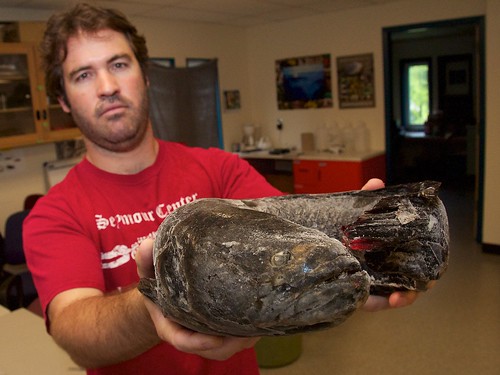
Snakehead fish“Snakehead Fish” photo of SFU biology grad student Michael Beakesis copyright (c) 2012 by Simon Fraser University Public Affairs and made available under a Creative Commons license.

Simon Fraser University, being in Canada, isn’t in our neck of the woods, but that photo is both awesome and available on flickr. Since this movie was clearly shot in Canada and not the Mid-Atlantic, and both it and this blog are low-budget enterprises, that seems appropriate. (Unlike syfy, this blog is not a profit-seeking entity and use of that photo doesn’t mean SFU condones anything in this post).

Trivia: 12 of the 15 actors credited on the Snakehead Terror IMDB page have appeared in an episode of Supernatural (even William B. Davis, the cigarette smoking man from the X-Files).

An interesting thing about this movie (no, really, this is interesting) is how much more strictly the old Saturday Night Craptaculars adhered to a (slightly) more sophisticated B movie aesthetic. The filmmakers could display a small bit of flare that suggested they do in fact possess a basic level of competence even if the budget doesn’t allow them the time or financing to truly display it. Decent editing. No extended day-for-night scenes. A few extra minutes clearly used to set the key and fill lights properly (and/or to actually use a 3 point lighting set up). Actors mostly hitting their marks. A modicum of wardrobe continuity.

B-movies have never been slick or glitzy (if they were they wouldn’t be B-movies), but Bruce Boxleitner’s hair doesn’t style itself and someone had to teach Carol Alt how to convincingly pronounce all those biologist words.

No, really, she’s convincing. As a biologist, maybe not as an action-movie actress.

Trivia: I’m fairly certain there is a jar of pickled snakehead in our refrigerator. I’m quite certain Husband should think carefully before he considers feeding it to me.

We still haven’t visited the Calvert Marine Museum’s invasive species exhibit, Eco Invaders.

I was going to post more about the movie, but I’ve gotten distracted by the fact that Bad Company is back together and touring and they’re playing at the Calvert Marine Museum, which just seems weird on all kinds of levels. Maybe it’s a really nice venue. I understand the museum is nice, but it’s a small museum far outside any metropolitan area, so the announcement immediately brought this to mind:

But hey, since Bad Company has figured prominently on Supernatural a few times, it seems only appropriate to mention it here. I’m on my first cup of coffee so it makes perfect sense to me.

Popular Culture Association/American Culture Association 2013

Home again after the Popular Culture Association/American Culture Association National Conference, which was a 4 day whirlwind. Think I’m kidding about the whirlwind part? Here’s the pdf of the schedule – it’s 501 pages long.

(The conference is actually going on until 9:45 tonight but we attended 3 panels between 8 a.m. and 1 p.m. and then our brains melted. Well, I can’t speak for Husband, but I can assure you mine did. While I’m writing this, I’m watching Project Runway and I’m having trouble following the plot. Yikes).

My conference paper on the TV show Supernatural was well-received and everyone else on the panel was fascinating so I was in great company:

horror (text, media, culture): television and New Media horror

“Translating tradition: domesticating seasonal horror through television.”
Derek Johnston (panel chair)

“Beyond salt and fire: the agency of human remains in the Supernatural Universe.”
Rebecca Stone Gordon

“Control is Being taken away from You”, Marble hornets and transmedia horror.
Ralph Beliveau and Amanda Kehrberg

I should probably edit the draft of my first TED DeExtinction post so I can get that online tomorrow. I intended to post about that last week and so it concludes with the delusional statement that I’d blog from the PCAACA conference. We can see how well that worked out.