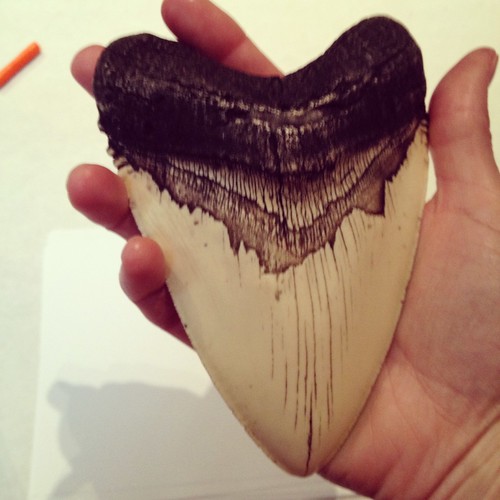
Megalodon fossil cast, image by MeanLouise.
edited at 8:20 p.m. to update some links.
The Discovery Channel’s annual Shark Week opened last night with a pseudo-documentary that is so abysmal that the words “fraudulent” and “bullshit” and “lies” are among the kinder assessments I’ve seen thus far. And I haven’t even looked very far.
The wildly differing goals of fiction films and documentaries are, I think, pretty well understood by most reasonable people. Crappy sci-fi or horror production houses aren’t big on maintaining a stable of science advisors. Hell, even the biggest budget movie or tv show will throw science to the wind in the pursuit of good storytelling.
It happens.
Sometimes, this becomes an opportunity for interesting conversation or an opening for some innovative science education programming. Other times it’s just a fun opportunity to get together with your science-y pals and have a few laughs.
Discovery is not the SyFy channel. Discovery purports to be a purveyor of science. Discovery needs to be held to a higher standard than Hollywood.
Discovery’s annual ichthyological bacchanalia has become an increasingly irresponsible blurring of fact and fiction and their sensationalization of the behavior of sharks – animals that are already misunderstood, over-fished and, in some cases, endangered.
This year, Discovery has taken things a step further, casting aside science in favor of science fiction delivered in a deliberately misleading fashion.
Christie Wilcox’s excellent piece, “Shark Week Jumps the Shark: An Open Letter to Discovery Communications,” is vital reading for anyone who doesn’t understand why paleontologists, conservationists, science communicators, documentarians, and ocean scientists, among others, are already pulling their hair out and tweeting madly about this year’s Shark Week.
This year’s Shark Week kick-off special, Megalodon: The Monster Shark That Lives, claimed to provide evidence that these massive beasts are still out there, using scattered anecdotes and scientific testimony to support the assertion. There’s only one problem: the entire “documentary” wasn’t real.
No whale with a giant bite taken out of it has ever washed up here in Hawaii. No fishing vessel went mysteriously missing off of South Africa in April. No one has ever found unfossilized Megalodon teeth. Collin Drake? Doesn’t exist. The evidence was faked, the stories fabricated, and the scientists portrayed on it were actors. The idea that Megalodon could still be roaming the ocean is a complete and total myth.
The heart of her argument is this:
The real science of these animals should have been more than enough to inspire Discovery Channel viewers. But it’s as if you don’t care anymore about presenting the truth or reality. You chose, instead, to mislead your viewers with 120 minutes of bullshit. And the sad part is, you are so well trusted by your audience that you actually convinced them: according to your poll, upwards of 70% of your viewing public fell for the ruse and now believes that Megalodon isn’t extinct.
The letter continues on as Wilcox outlines the reasons for her fury and ends with samples from Discovery’s facebook wall that show that she is far from alone in condemning their absurd content. You should go read the whole thing. It’s not that long, you can spare the time.
I was even more disappointed in Discovery for Megalodon: The Monster Shark that Lives than I was for the hoax-y “mermaids are real” programs they’ve run the last two Memorial Day weekends. See also: Valerie Strauss’s Washington Post article, Mermaids: The official U.S. position (yes, there is one) (which raises serious points. Go read it). See also: Southern Fried Science – Mermaids: The New Evidence is a Fake Documentary. See also: National Oceanic and Atmospheric Administration’s statement on aquatic humanoids.
Jacquelyn Gill has a timely guest-post on her blog, The Contemplative Mammoth, by PhD students Meghan Balk and Catalina Pimiento. I suggest reading The Megatooth Shark: Megalodon to learn actual things.
If your kids watched this fetid show, I suggest downloading the University of Florida’s Megalodon educator’s guide. UF is also the home of the Florida Museum of Natural History’s International Shark Attack File, a great source for dispelling some of the myths and rumors programming like Shark Week disseminates in the name of ratings and profit.
Want some interesting (and intelligent) shark week commentary (52 weeks a year) on twitter? Start with David Schiffman, aka @WhySharksMatter. And perhaps turn off Discovery in favor of Nat Geo Wild’s Sharkfest. I’ve heard rumors it will have real science. Instead of, you know, bullshit and rumors.
updated to add links to other indignant blog posts:
It’s Okay to be Smart: “Shark Weak” (good title).
Wil Wheaton: “Discover Channel Owes it’s Viewers an Apology.”